The Krzyżowa Foundation for European Understanding has been combining art with history and education for years. As part of the Konrad and Paweł Jarocki International Artist Residency Program, creators come to Krzyżowa who seek new forms of dialogue between the past and the present in their work. This year's edition of the program focuses on painting and experimentation.
The invited artists include:
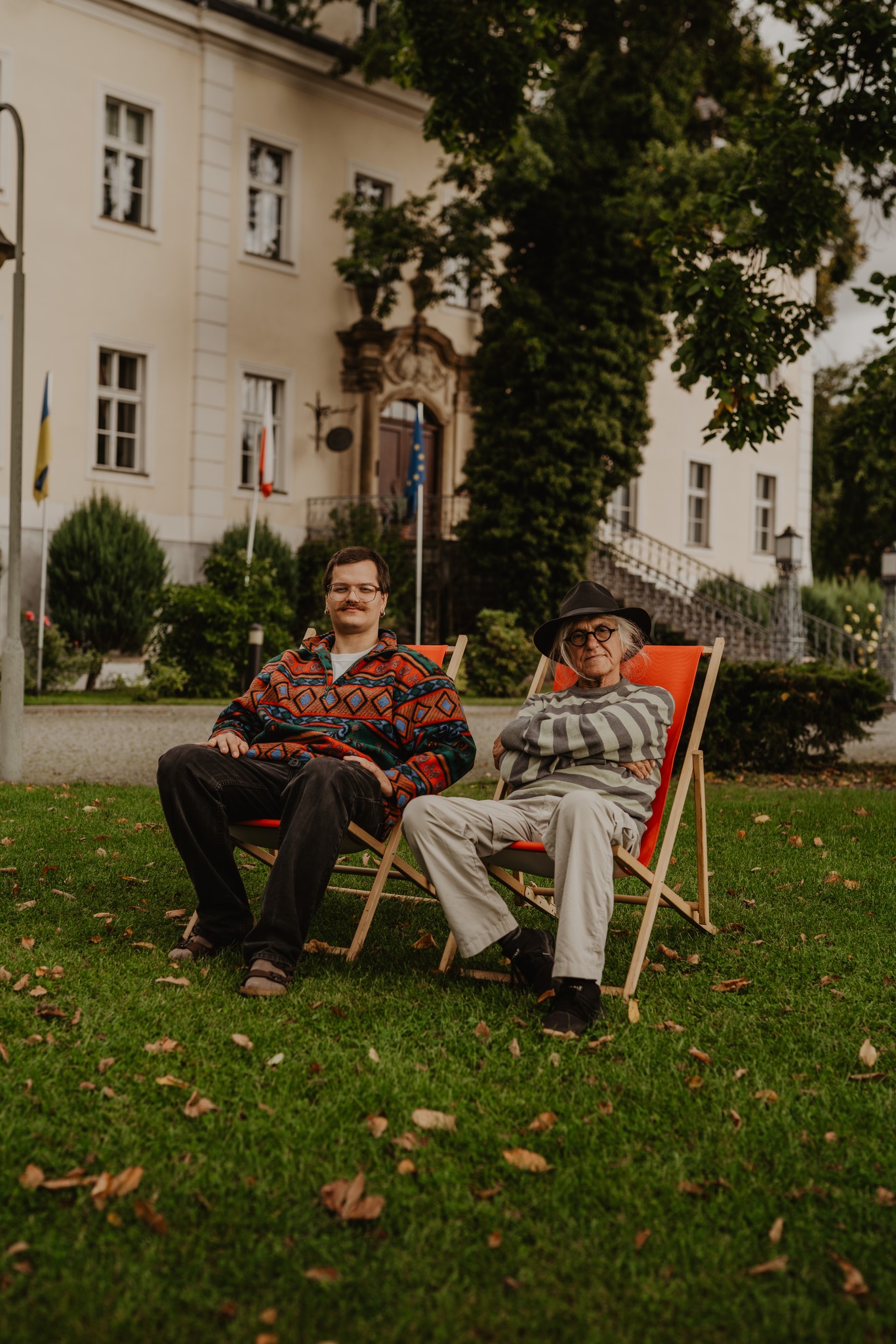
Adam Rzepecki – performer, painter, sculptor, author of films and installations, co-founder of the legendary Łódź Kaliska group and the Supergroup UNDERGROUND KRAKOWSKI. His practice has been setting new directions in Polish contemporary art since the 1980s. In Krzyżowa, Adam tackles the theme of time—personal, historical, and cosmic. During the residency, he is working on a monumental panorama of the sky over Krzyżowa, as well as a "starry sky diary," painted day by day during his stay. He is also planning workshops for young people where participants will have the opportunity to try the decalcomania technique, creating a joint Polish-German installation.
Aliaksandr Danilkin – a young-generation painter from Belarus, currently living and working in Wrocław. His art grows from the experience of Belarusian folklore and his own history related to resistance against the regime in his homeland. In Krzyżowa, the artist is developing a project inspired by malyavanky—traditional Belarusian painted rugs. He is creating large-format paintings and ceramic objects that transpose the ancient aesthetic into the context of a place associated with resistance against totalitarianism and the building of reconciliation. Danilkin will also lead workshops where young people can create their own "story rugs," discovering folk art as a language of memory and identity.
The program supports creators in their work but also opens up the space of Krzyżowa to new interpretations of its history. As the organizers emphasize, the goal of the residency is to "test how, with the help of contemporary art, we can conduct dialogue and build intercultural relations."
Krzyżowa, a place of Polish-German memory and dialogue, is once again becoming a space for artistic experiments, meetings, and discussions for the third time.