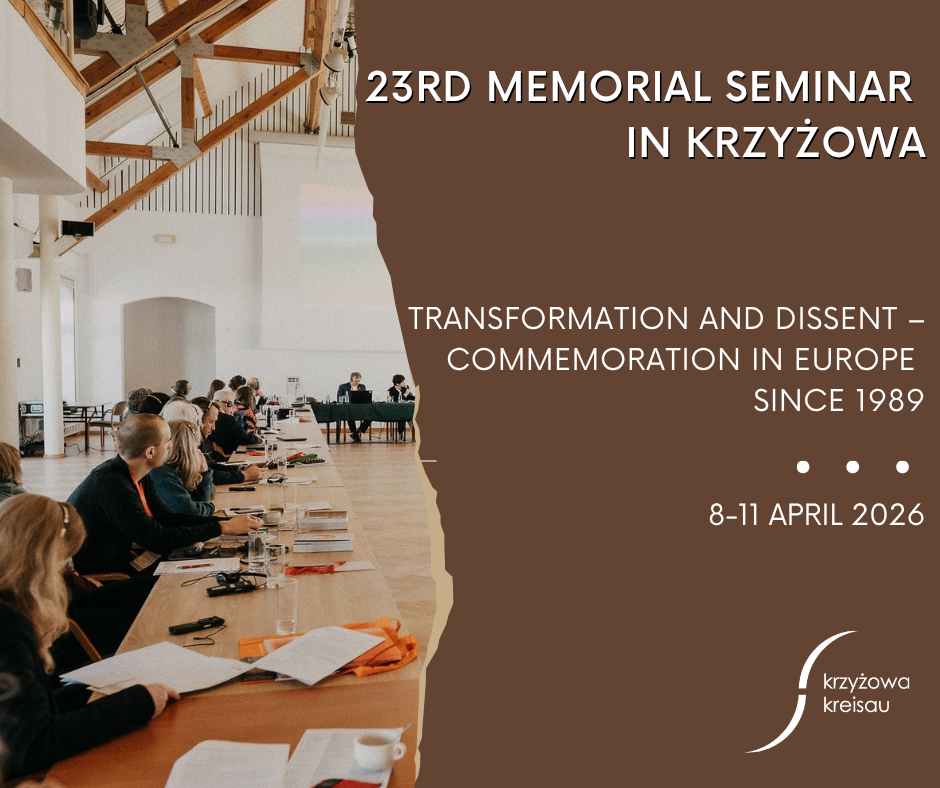
„Transformation and Dissent – Commemoration in Europe since 1989”
Memory is rarely harmonious: it is conflictual, polyphonic, and shaped by social contestation. After 1989/90, narratives about mass violence, Nazi crimes and communist rule collided in memorial sites across Eastern and Western Europe. These tensions are rooted, on the one hand, in the prescribed antifascism of the GDR and other Eastern European states, and on the other, in West German and Western European interpretations of National Socialism that long marginalized the crimes committed under communist regimes. The struggle over Holocaust remembrance and the commemoration of Stalinist mass violence was marked by processes of negotiation and gave rise to new debates about previously overlooked victim groups.
Memory does not lead to consensus but is characterized by dissent—productive when made visible and capable of sparking debate. The 2026 Memorial Conference focuses on the transformation of European sites of memory and learning after 1989/90 and asks: How have narratives, institutions, and museums changed since 1989? How controversial were these transformations locally and within their societies? What conflicts shaped them, and how are these reflected, curated, or even silenced in the histories and educational work of memorial institutions themselves?
The conference operates within a field significantly shaped by Memory Studies. It examines how the past is remembered in the present by applying interdisciplinary analytical frameworks to narrative and museological representation. Which individual, collective, and national memories emerge in specific contexts and shape interpretive frameworks? Who holds power over the attribution of meaning? And how is it decided which narratives become dominant?
Cultures of remembrance are not only shaped by governments and institutions but also by civil society actors—victims’ associations, NGOs, and social movements. Debates over narratives of remembrance are themselves a form of democratic participation: conflictual, yet precisely through that, vital and dynamic. At stake are the tensions between remembering and forgetting, and the recognition of diversity without relativizing suffering.
Since 1989/90, the democratization of remembrance in Europe and the visibility of previously marginalized experiences have expanded to include new themes. Today, we observe tendencies both to pacify conflicts and to embrace them as productive sites of contestation. This is particularly visible in the concept of multidirectional memory: In Krzyżowa, we aim to explore how various histories of violence—Holocaust, Stalinism, and colonialism—can illuminate rather than compete with one another.
These theoretical insights are highly relevant to memorial practice. Professionals working in museums and memorial sites face the daily challenge of representing history from multiple perspectives, offering competing interpretations, and enabling visitors to engage with historical complexity and differentiation. The conference in Krzyżowa seeks to empower participants to address these challenges while integrating perspectives from Western, Eastern, and Central Eastern Europe. Until 1989, remembrance culture and policy in both East and West were dominated by the memory of Nazi crimes. Only after the collapse of the communist regimes in 1990 did it become possible to address the experiences of communist dictatorship more fully.
.png)
Infopack